



Telugu Kids Corner
A safe cultural learning space for Telugu kids in USA and worldwide — rhymes, stories, language, our festivals.
Telugu Rhymes & Songs
36 rhymes with Telugu lyrics & transliteration
Grandma Stories
244 moral stories across 10 categories
Animal fables with moral lessons
Traditional Telugu Kids Games
50 traditional games with rules
Learn Telugu
Especially for US Telugu kids — alphabets, words, colors, numbers
Festivals for Kids
Our Telugu festivals — explained simply

Ugādi, Yugādi or also known as Saṁvatsarādi, is the first day of the year on the Hindu calendar. It is traditionally celebrated by the Kannadigas and Telugu people in the Indian states of Andhra Pradesh, Karnataka and Telangana, in some parts of Tamil Nadu and Kerala, as well as by diaspora communities elsewhere. The cycle consists of 60 years—each year individually named. It is observed on the first day of the Hindu lunisolar calendar month of Chaitra. This typically falls in late March or early April of the Gregorian calendar. It also sometimes falls on the day after Amavasya with the 27th Nakshatra Revati. Ugadi Day is pivoted on the first new moon after the March equinox.

Makar(a) Sankrānti, also referred to as Uttarāyana, Makara, or simply Sankrānti, is a Hindu observance and a mid-winter harvest festival in India and Nepal. It is typically celebrated on 14 January annually, this occasion marks the transition of the sun from the zodiac of Sagittarius (dhanu) to Capricorn (makara). As this transition coincides with the sun's movement from south to north, the festival is dedicated to the solar deity, Surya, and is observed to mark a new beginning. Across India, the occasion is celebrated with numerous multi-day festivals.
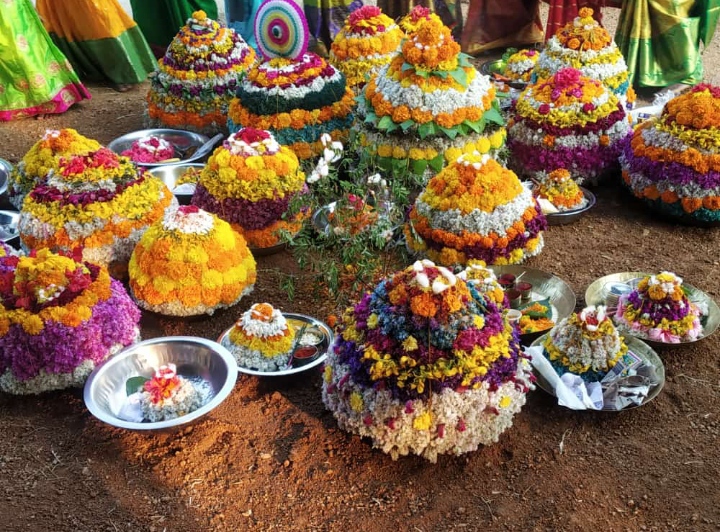
Bathukamma is a flower-festival celebrated by Telugu Hindu women of Telangana and some parts of Andhra Pradesh. Every year this festival is celebrated as per the Sathavahana calendar for nine days starting on Pitru Amavasya, which usually coincides with the months September–October of the Gregorian calendar. Bathukamma is celebrated for nine days and corresponds to the festivals of Sharad Navratri and Durga Puja. It starts on the day of Mahalaya Amavasya and the 9-day festivities culminate on "Saddula Bathukamma" or "Pedda Bathukamma." Bathukamma is followed by Boddemma, which is a 7-day festival. The Boddemma festival that marks the ending of Varsha Ruthu whereas Bathukamma marks the beginning of Sarad or Sharath Ruthu.

Bonalu is a traditional festival centred on the Hindu goddess Mahakali from Telangana. This festival is celebrated annually in the twin cities of Hyderabad and Secunderabad, as well as in other parts of the state. It is celebrated in the month of Ashada Masam, which is around July and/or August. Special "poojas" are performed for Yellamma on the first and last day of the festival. The festival is also considered a thanksgiving to Mahakali for fulfillment of vows.

Ganesh Chaturthi, also known as Vinayaka Chaturthi, Vinayaka Chavithi, or Vinayagar Chaturthi, is a Hindu festival that is dedicated to the Hindu deity Ganesha. The festival is marked with the installation of Ganesha's murtis, privately in homes and publicly on elaborate pandals. Observances include chanting of Vedic hymns and Hindu texts, such as prayers and vrata (fasting). Offerings and prasada from the daily prayers, which are distributed from the pandal to the community, include sweets such as modak, as it is believed to be a favourite of Ganesha. The festival ends on the tenth day after its start, when the murti is carried in a public procession with music and group chanting, and then immersed in a nearby body of water such as a river or sea, called visarjana on the day of Ananta Chaturdashi. In Mumbai and alone, around 150,000 murtis are immersed annually. The villages Like saidapuram ,kadapa dist ,andhra Pradesh will Celebrate with every people in Village And Their Youth Name is Chatrapathi Shivaji Maharaj Youth It is a state festival of Indian state Maharashtra.

Vijayadashami, more commonly known as Dasara, or Dassahra, and also known as Dashāhra or Dashain in Bhojpuri, Maithili and Nepali, is a major Hindu festival celebrated every year at the end of Durga Puja and Navaratri. It is observed on the tenth day of the waxing moon in the month of Ashvin, the seventh in the Hindu lunisolar calendar, and falls in the Gregorian calendar months of September and October.
Telugu Values & Culture
Identity-building lessons for second-generation Telugu kids
Share Your Stories!
Parents, grandparents — share rhymes, stories, childhood memories. Help build a Telugu cultural archive.
Submit Your Telugu Story